2025 Water Quality Report Released
SPRINGVILLE WATER QUALITY REPORT – 2025
Introduction: In compliance with the Safe Drinking Water Act Amendments, The City of Springville’s water system is providing its customers with the annual water quality report. This report explains where your water comes from, what it contains, and how it compares to standards set by regulatory agencies. For more information about your drinking water, please contact Todd Wyman, Public Works Director, at 319-854-6428.
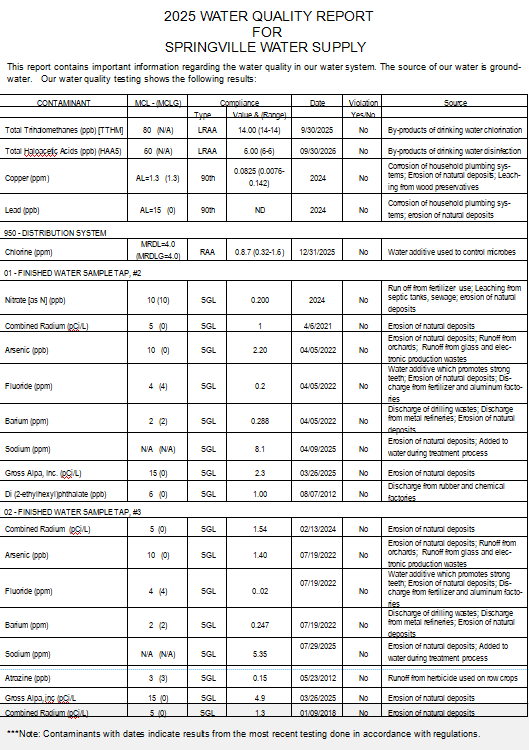
Does my drinking water meet EPA standards? Yes, our water meets all of EPA’s standards. We sample for over 80 contaminants that may be in drinking water. As you will see in the table contained in this report, we found all contaminants always met the EPA guidelines.
What is the source of my water? Your water comes from two municipal wells. One well is 473 feet and the other is 390 feet into an underground source of water called the Silurian Dolomite Formation. These wells are located at the water tower and at the east end of the football field. The town owns the land where the wells are located and restricts any activity that could pollute them to ensure the safety of our water. The State has completed a source water protection evaluation. The Springville water supply obtains its water from the Silurian aquifer. The Silurian aquifer was determined to be highly susceptible to contamination because the characteristics of the aquifer and overlying materials allow contaminants to move through the aquifer fairly quickly. The Springville wells will be most susceptible to activities such as leaking underground storage tanks, pesticide manufacturers, and air release permitted sites. A detailed evaluation of your source water was completed by the Iowa Department of Natural Resources and is available from the City of Springville at the city clerk’s office at 304 Broadway, 8:00 to noon and 1 to 4:30 p.m., M-F, 319-854-6428.
How can I get involved? Our City Council meets on the first and third Mondays of each month at 6:00 p.m. in City Hall at 304 Broadway, Springville. Please feel free to participate in these meetings.
Is our water system meeting other rules that govern our operations? In order to ensure that tap water is safe to drink, EPA prescribes regulations which limit the number of certain contaminants in water provided by public water systems. FDA regulations establish limits for contaminants in bottled water, which must provide the same protection for public health. The State and EPA require us to test our water on a regular basis to ensure its safety.
Do I need to take special precautions? Some people may be more vulnerable to contaminants in drinking water than the general population. Immuno-compromised persons such as persons with cancer undergoing chemotherapy, persons who have undergone organ transplants, people with HIV/AIDS or other immune system disorders, some elderly, and infants can be particularly at risk from infections. These people should seek advice about drinking water from their health care providers. EPA/CDC guidelines on appropriate means to lessen the risk of infection by Crptosporidium and other microbial contaminants are available from the Safe Drinking Water Hotline (800-426-4791).
Why are there contaminants in my water? Drinking water, including bottled water, may be reasonably expected to contain at least small amounts of some contaminants. The presence of contaminants does not necessarily indicate that water poses a health risk. More information about contaminants and potential health effects can be obtained by calling the Environmental Protection Agency’s Safe Drinking Water Hotline (800-426-4791).
If present, elevated levels of lead can cause serious health problems, especially for pregnant women and young children. Lead in drinking water is primarily from materials and components associated with service lines and home plumbing. The City of Springville is responsible for providing high quality drinking water but cannot control the variety of materials used in plumbing components. When your water has been sitting for several hours, you can minimize the potential for lead exposure by flushing your tap for 30 seconds to 2 minutes before using water for drinking or cooking. If you are concerned about lead in your water, you may wish to have your water tested.
Information on lead in drinking water, testing methods and steps you can take to minimize exposure is available from the Safe Drinking Water Hotline or at http://www.epa.gov/safewater/lead.
The sources of drinking water (both tap water and bottled water) include rivers, lakes, streams, ponds, reservoirs, springs, and wells. As water travels over the surface of the land or through the ground, it dissolves naturally occurring minerals and, in some cases, radioactive material, and can pick up substances resulting from the presence of animals or from human activity.
Contaminants that may be present in source water include:
- Microbial contaminants, such as viruses and bacteria, may come from sewage treatment plants, septic systems, agriculture livestock operations and wildlife.
- Inorganic contaminants, such as salts and metals, which can be naturally occurring or result from urban stormwater runoff, industrial or domestic wastewater discharges, oil and gas production, mining or farming.
- Pesticides and herbicides, which may come from a variety of sources such as agriculture, stormwater runoff, and residential uses.
- Organic chemical contaminants, including synthetic and volatile organic chemicals, which are by-products of industrial processes and petroleum production, and can also come from gas stations, urban stormwater runoff, and septic systems.
- Radioactive contaminants, which can be naturally occurring or be the result of oil and gas production and mining activities.
Health Affects of Lead in Your Drinking Water: If present, elevated levels of lead can cause serious health problems, especially for pregnant women and you children. Lead in drinking water is primarily from materials and components associated with service lines and home plumbing. Springville is responsible for providing high quality drinking water but cannot control the variety of materials used plumbing components. When your water has been sitting for several hours, you can minimize the potential for lead exposure by flushing your tap for 30 seconds to 2 minutes before using water for drinking or cooking. If you are concerned about lead in your water, you may wish to have your water tested. Information on lead in drinking water, testing methods, and steps you can take to minimize exposure is available from the Safe Drinking Water Hotline or at http://www.epa.gov/safewater/lead.
Other Information: Our water system is currently working with the community to increase awareness of proper waste disposal practices, to further protect the source of our drinking water. We are also working with other agencies and local watershed groups to educate the community on ways to keep the water safe.
Water Quality Data Table: The water quality data table on the next page lists all the contaminants that were detected during monitoring for the 2024 calendar year. The presence of these contaminants in the water does not necessarily indicate that the water poses a health risk. Most of the data presented in this table is from testing done between January 2012 to December 31, 2025. The State requires us to monitor contaminants less than once per year because the concentration of these contaminants is not expected to vary significantly from year to year. Definitions of the terms used in the table and explanations of the abbreviations are as follows:
Definitions:
MRDLG: The level of a drinking water disinfectant below which there is no known or expected risk to health. MRDLGs do not reflect the benefits of the use of disinfectants to control microbial contaminants.
MCLG: Maximum Contaminant Level Goal, or the level of a contaminant in drinking water below which there is no known or expected risk to health. MCLGs allow for a margin of safety.
MRDL: The highest level of disinfectant allowed in drinking water. There is convincing evidence that addition of a disinfectant is necessary for control of microbial contaminants.
- MRDLs are set for chloramines, chlorine, and chlorine dioxide.
MCL: Maximum Contaminant Level, or the highest level of a contaminant that is allowed in drinking water. MCLs are set as close to the MCLGs as feasible using the best available treatment technology.
AL: Action Level, or the concentration of a contaminant which, when exceeded, triggers treatment or other requirements which a water system must follow.
Abbreviations:
- ppb: parts per billion or micrograms per liter
- ppm: parts per million or milligrams per liter
- pcil: picoCurie parts per liter
- N/a: not applicable
- TT: treatment technique
- MRDLG: maximum residual disinfectant level goal
- MRDL: maximum residual disinfectant level
- N/d: not detectable at testing limits.
Table of Contents:
- Regulated contaminants *detected* must be included.
- Contaminant name
- MCLG
- MCL
- Level of detection & if applicable range
- Likely source of contamination
- Indicate any violation of MCL, MRDL, TT, or AL